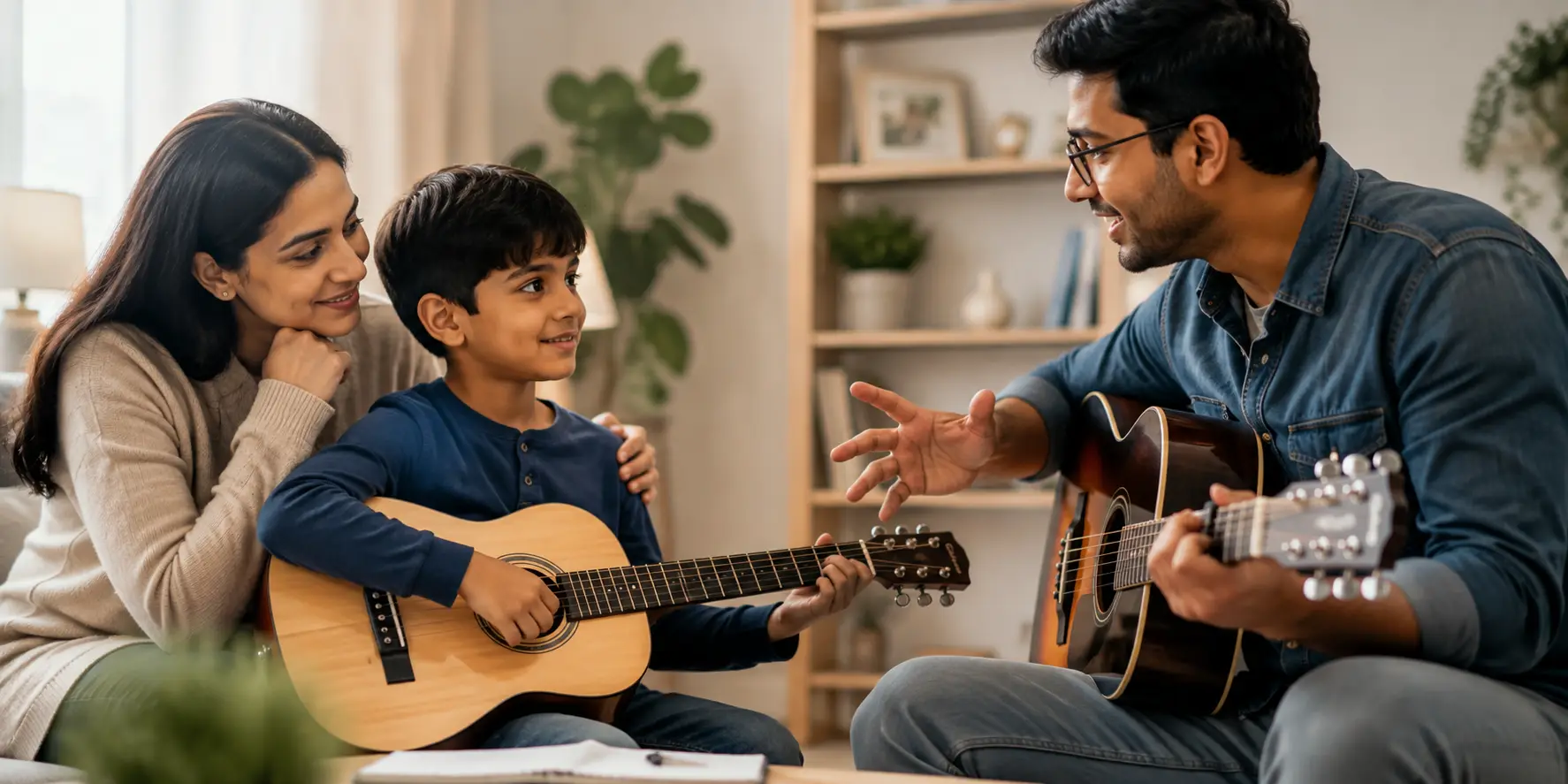
The best online guitar teacher for your child is someone who teaches your child directly and consistently (not a rotating roster of instructors), has a clear beginner curriculum, can teach both Western and Indian/Bollywood repertoire if that matters to your family, and offers a trial lesson before you commit. Price and flashy marketing matter less than whether your child actually looks forward to the next class.
If you’re a parent in the US raising a musically curious kid — and you want them to stay connected to Bollywood songs, Indian film music, or the sound of home while also learning proper guitar technique — the teacher you pick matters more than the platform, the app, or the certificate at the end. Here’s how to actually evaluate one.
Why Online Guitar Lessons Work Well for Indian Families in the US
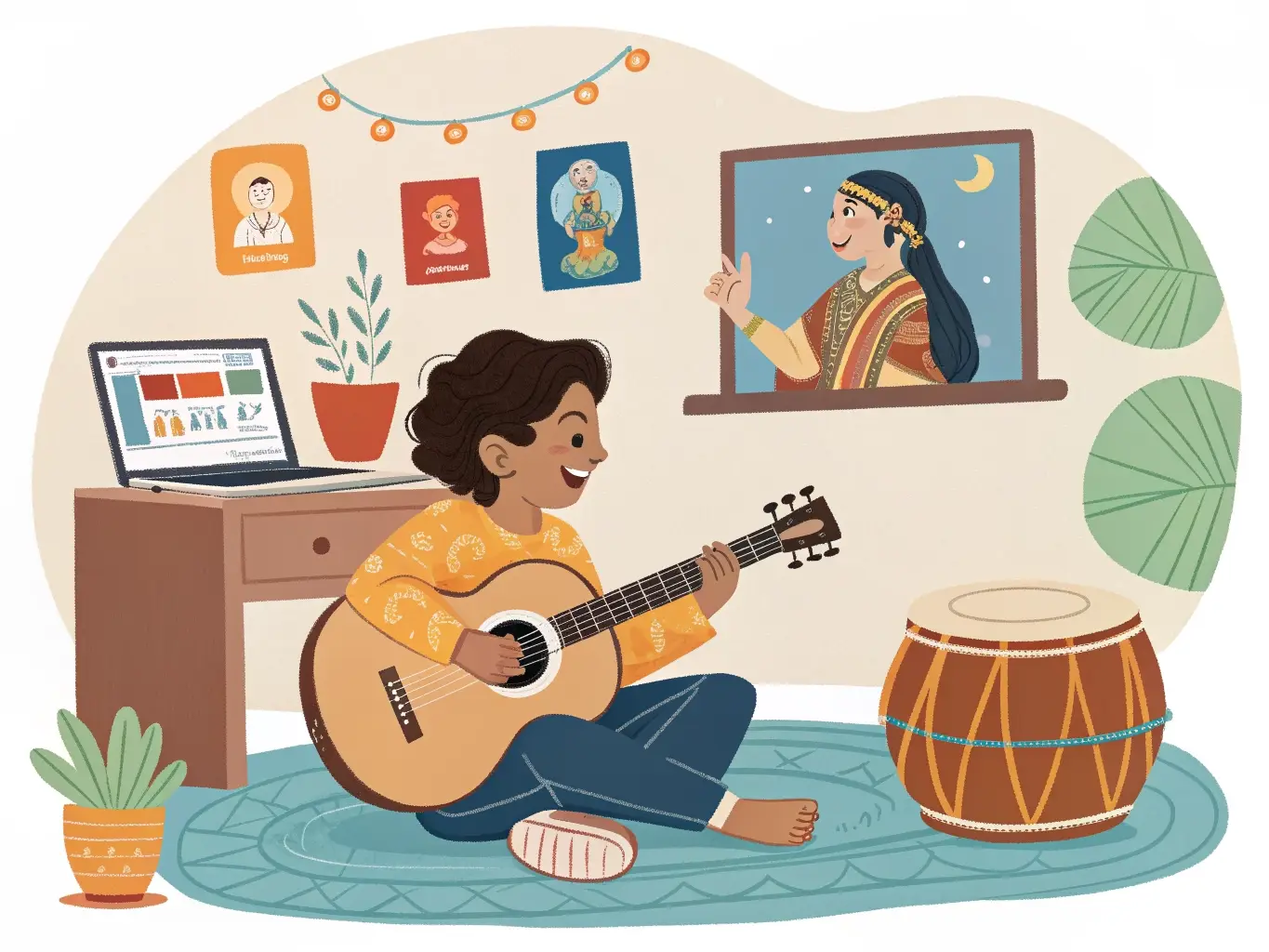
Finding a guitar teacher who understands both Western music theory and the Indian musical ear — the ornamentation, the film-song phrasing, the specific way a Bollywood melody bends a note — is hard to do locally in most US cities. Online lessons remove that constraint. Your child gets access to teachers who grew up on the same music you did, without you needing to drive 40 minutes across town for a weekly lesson.
It also solves a scheduling problem specific to diaspora families: weekday evenings packed with school, homework, and other activities, plus weekend commitments to temple, community events, or Hindi/Gujarati/Tamil school. A good online teacher works around that, not against it.
7 Things to Look For in an Online Guitar Teacher
- One consistent teacher, not a rotating pool. Kids learn faster and stick with an instrument longer when they build a relationship with one person who remembers what they struggled with last week. If a platform assigns a different instructor every few sessions, that consistency is gone.
- A real curriculum, not just “pick a song and go.” Ask what your child will be able to play after 4 weeks, 3 months, and 6 months. A teacher who can answer that specifically has a plan. A teacher who says “we’ll see how it goes” doesn’t.
- Comfort teaching Indian and Western repertoire. If you want your child to eventually play “Tum Hi Ho” or “Kesariya” alongside “Wonderwall” or “Perfect,” confirm the teacher actually teaches Bollywood and Indian film music — not every Western-trained guitar teacher does this well, and not every Indian teacher is strong on Western technique either. You want both.
- A trial lesson before any long-term commitment. Any teacher confident in their teaching will let your child sit in on one lesson first. Watch how your child responds — do they relax, ask questions, want to keep going? That reaction tells you more than any review page.
- Clear, judgment-free communication with parents. You should get real updates — what was covered, what to practice, what’s coming next — not just a generic “great progress!” message every week.
- A practice plan that fits real family life. 10–15 focused minutes a day beats an hour of unstructured practice once a week. Ask how the teacher structures practice for a beginner with a school schedule.
- A teaching style that matches your child’s personality. Some kids need structure and repetition. Others need to be handed a song they love and reverse-engineered into it. Neither is wrong — but the wrong fit is why kids quit.
Questions to Ask Before You Enroll
- Will my child have the same teacher every week, or does that rotate?
- What will my child be able to play after the first month?
- Can you teach Bollywood/Indian film songs alongside Western basics?
- What happens if we need to reschedule around exams, festivals, or travel to India?
- Is there a trial lesson, and what does it cost?
- How do you communicate progress to parents?
- What’s the plan if my child loses motivation around week 6 or 7 (which is extremely common)?
Red Flags to Watch For
- No trial lesson offered, or heavy pressure to sign a long-term contract immediately.
- Vague answers about who the actual teacher will be.
- A curriculum that’s 100% generic Western method books with zero flexibility for the music your child actually wants to play.
- Reviews and testimonials that all sound identical, or that emphasize the brand over any specific teacher.
- No clear answer on what a realistic first month looks like.
Why a Personal, Teacher-Led Approach Often Works Better Than a Big Academy
Large academies are good at scale — big course catalogs, structured levels, a recognizable name. What they’re often not built for is a teacher who actually knows your child’s name, remembers that they struggled with barre chords two weeks ago, and adjusts the next lesson because of it.
If you’re weighing a big-brand academy against a smaller, founder-led or teacher-led studio, ask the big-brand academy directly: “Will my child have the same teacher every single week, and can I talk to that teacher directly if I have a concern?” The answer tells you a lot.
Frequently Asked Questions
What age should my child start online guitar lessons?
Most teachers find 7–8 years old is a practical starting point for standard-size guitars, though smaller travel or half-size guitars can work for kids as young as 5–6 if they’re motivated. The bigger factor than age is attention span and genuine interest — a curious 6-year-old often does better than a reluctant 10-year-old.
How long before my child can play a full song?
With consistent 10–15 minute daily practice, most beginners can play a simple full song (think basic strumming, 3–4 chords) within 4–8 weeks.
Do online guitar lessons work as well as in-person ones?
For most beginners and intermediate players, yes — especially with a dedicated teacher, a decent internet connection, and a webcam angle that shows hand position clearly. The relationship and consistency matter more than the medium.
Can an online teacher really teach Bollywood songs well?
Yes, if the teacher has genuine training in both Indian and Western music. Ask directly about their background — a teacher who grew up learning both traditions will typically explain phrasing and ornamentation in a way a purely Western-method teacher can’t.
What should I do if my child wants to quit after a month?
This is normal and usually not about the instrument — it’s about the song selection or pacing. Talk to the teacher about switching to a song your child actually loves before deciding to stop lessons altogether.
Musician Teacher offers 1:1 online guitar lessons taught personally by our Founder, built for Indian-origin kids and adults growing up in the US who want to learn guitar the right way — Bollywood, Indian classical crossover, and Western technique, all from a teacher who actually knows their name. Book a trial lesson today.